COMMENTARY • EUROPEAN AFFAIRS
How Germany Keeps Strengthening the AfD
For thirteen years, Germany has deployed sophisticated strategies to contain the rise of the far right. None of them have worked. Some have made things considerably worse. An analysis of a self-inflicted crisis and what would actually help.
I
need to begin with a disclosure, because in Germany today it is apparently no longer possible to discuss certain subjects without being immediately categorised. So here it is: I am a European federalist. I believe passionately in a united, capable Europe - it is the core of my political conviction. Culturally, I lean towards the liberal-conservative side of things. I would struggle to place myself on a simple spectrum, because in what passes for the culture war, I hold broadly liberal positions: I support the base ideas of the LGBTQ+ movement, I am entirely uninterested in your identity as a political category - I see you first as a human being. At the same time many would call me right wing for calling for a restrictive, federal migration policy.
To most people, that makes me either a center-right or a liberal-right figure, depending on who you ask. That framing is itself revealing. Because I am simultaneously the person saying: the AfD is a toxic, poisonous party, and its policy proposals are, in large part, neither desirable nor remotely workable. Especially now since I am independent from Ave Europa and movements in that space, I have a quite unbiased view on most european matters. That these two positions can coexist - rejecting the AfDs around Europe whilst still trying to understand and win back its voters - is apparently regarded as suspicious in Germany today. That is the first problem we need to discuss.
Thirteen years, always the same strategy
TThe AfD has existed for roughly thirteen or fourteen years. In that time, Germany has pursued a remarkably consistent strategy to fight it: exclusion, silence, denial of platform. The milieu that imposed this strategy is drawn predominantly from an academically shaped, liberal-left world. These are self-confirming echo chambers operating from a great moral height, from which they pronounce: one does not speak with the right. One does not offer them a stage. Note the inflation of the term. "The right" in this framing begins, at the very latest, with the CSU. The boundary of what is discussable has been shifted steadily leftwards over the years, and what falls outside that boundary must simply be silenced. The result, after thirteen years, is visible to anyone willing to look: the AfD is stronger than it has ever been.
" Current polls place the AfD at 30 to 31 per cent nationally, making it the strongest single party ahead of the CDU. In Saxony-Anhalt, it has reached over 41 per cent in recent surveys. Among voters aged 16 to 55, the generation that sustains the economy, it ranks amongst the dominant forces alongside parties of the hard left."
These are not abstract figures. This is a democratic earthquake unfolding in slow motion. And the establishment's response remains: more of the same.
"'Whoever says they won't offer a platform is implicitly admitting they cannot win the argument.'"
The Höcke affair, and what it reveals
For readers outside Germany, a brief introduction to Björn Höcke. He is the figurehead of the AfD's radical wing, known for provocative statements in uncomfortably close proximity to National Socialist rhetoric and the subject of multiple court proceedings over quotations from Nazi speeches. There circulates a widely repeated and frequently exaggerated claim that a court officially designated him a fascist. What actually happened is that a court dismissed a defamation claim, which many interpreted as judicial endorsement of the label. It was not. It was a finding that the word was not, in this particular context, criminally actionable. That is a rather different thing, but it illustrates perfectly how the discourse around Höcke operates: polemical on all sides.
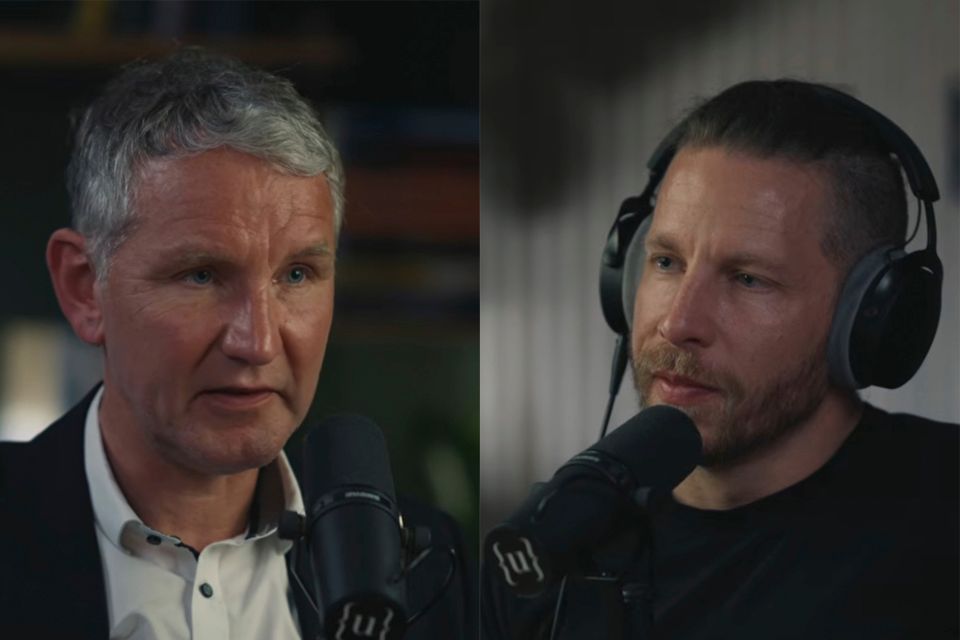
This same man, who commands the support of nearly forty per cent of voters in Thuringia, appeared on the podcast "Ben ungeskripted," a format that invites literally anyone to speak, unscripted and unedited: Mafia informants, left-wing politicians, entertainers. Four and a half hours. I watched it. It was, frankly, largely tedious. It amounted to a long, almost poetic demonstration of the emptiness that characterises so much of German political life. Little substance, few concrete answers. What was interesting was not the interview itself. It was the reaction of the mainstream to it. Fromer SPD co-leader Saskia Esken weighed in with a distinctly threatening tone, suggesting that companies which had advertised on the podcast ought to reconsider promptly. No argument against Höcke's positions. No counter-proposal. Just economic pressure on an independent podcaster for having allowed someone to speak whose views the party chair would rather not see circulated. This response went largely unexamined. It should not have done.
What "Dekarldent" said.
I want to cite someone with whom I share very little politically, and I do so deliberately, because it demonstrates that this insight is not the exclusive property of the right. The left-wing activist and content creator known as "Dekarldent" is a German now living in Ireland who makes his living commenting on political content from a hard left-wing perspective. He said something after the Höcke interview that I find myself in complete agreement with. Whoever pursues the strategy of no conversation, no platform, no discourse is implicitly saying: these opinions and arguments are so powerful and so persuasive that millions of people would immediately adopt them the moment they heard them. Therefore we must protect the public by not letting them hear. That is not strength. It is an admission of argumentative weakness.
"That would imply that Höcke’s arguments are good — and I don’t believe they are." - Dekarldent"
The three pillars of AfD growth
I would argue that the AfD draws its support from essentially three sources, and none of them have much to do with the persuasive force of its actual programme.
The first pillar is establishment failure. The CDU and SPD have spent years competing vigorously in incompetence. There is a €500 billion special fund of which, by most credible accounts, the great majority is being diverted from its stated purpose. We have, in 2026, a CDU Chancellor claiming to have resolved the migration crisis, a claim that does not survive contact with reality. We have an explosion in the cost of living that is, for large sections of the population, barely sustainable.
And the establishment's response, with admirable consistency, is: everything is essentially fine, do not make such a fuss. That this fertilises the ground for a protest party whose core product is outrage requires no further elaboration.
The second pillar is the monopolisation of the migration debate. Because in Germany any serious discussion of migration restrictions is reflexively associated with National Socialism, I have experienced at first hand how rapidly this happens and how aggressively it is pursued. The CDU has, with few exceptions, abandoned this terrain entirely. Bad press from the established media is to be avoided at all costs. The result is that one of the defining political questions of our era, ranked as the number-one concern by the 30-to-55 age group that sustains the German economy, has been handed to an anti-European, pro-Russian party. This is not a moral achievement. It is a comprehensive political failure.
The third pillar is the outrage dynamic itself. Every article that demonises Höcke without refuting him, every call for a boycott, every demand for de-platforming confirms the AfD's central narrative: that the existing system must suppress certain views because it cannot defeat them in argument. It is like trying to squeeze a spot until it gets worse and worse. Or, to use another image: like attempting to extinguish a fire with paper.
What left-wing cultural hegemony has to do with all this
There is a further point that must be named honestly, even if it is uncomfortable. Cultural hegemony in Germany has rested with the left for roughly fifty years. This was built carefully and consistently in the media, in universities, in the arts and across much of public broadcasting. That is not a conspiracy theory; it is a sociological observation. This hegemony is what imposed the unwritten code of conduct I described at the outset.
The problem is that cultural hegemony generates counter-movements. When political conversation is persistently narrowed in one direction, pressure builds and eventually releases somewhere. In Germany, it is releasing through the AfD and through figures like Martin Sellner, the Austrian ideologue of the so-called Identitarian movement, who has achieved national notoriety with concepts such as "remigration." Sellner is, in substantial measure, a caricature, but he is a caricature with an audience. He built that audience not despite the exclusion strategy but partly because of it.
Social media has amplified this dynamic enormously. Sellner on one flank and assorted hard-left voices on the other sandwich the political centre with radical positions and set the terms of the narrative. The centre has little to offer against these digital flanking attacks so long as it fails to provide convincing solutions to real problems.
"The CDU could strip the AfD of half its voters within two days - if it chose to."
The Magyar model and what Europe can learn from it
There is one figure who gives me genuine cause for optimism: Péter Magyar in Hungary. He is a politician who emerged from within the Orbán system, who understands how it operates from the inside, and who has nevertheless built a genuinely pro-European political force. What Magyar demonstrates is that it is possible to speak to disenchanted right-wing voters without adopting their worldview. It is possible to take questions of migration, security and national identity seriously without descending into populism, and it is possible to do all of this whilst remaining ardently pro-European.
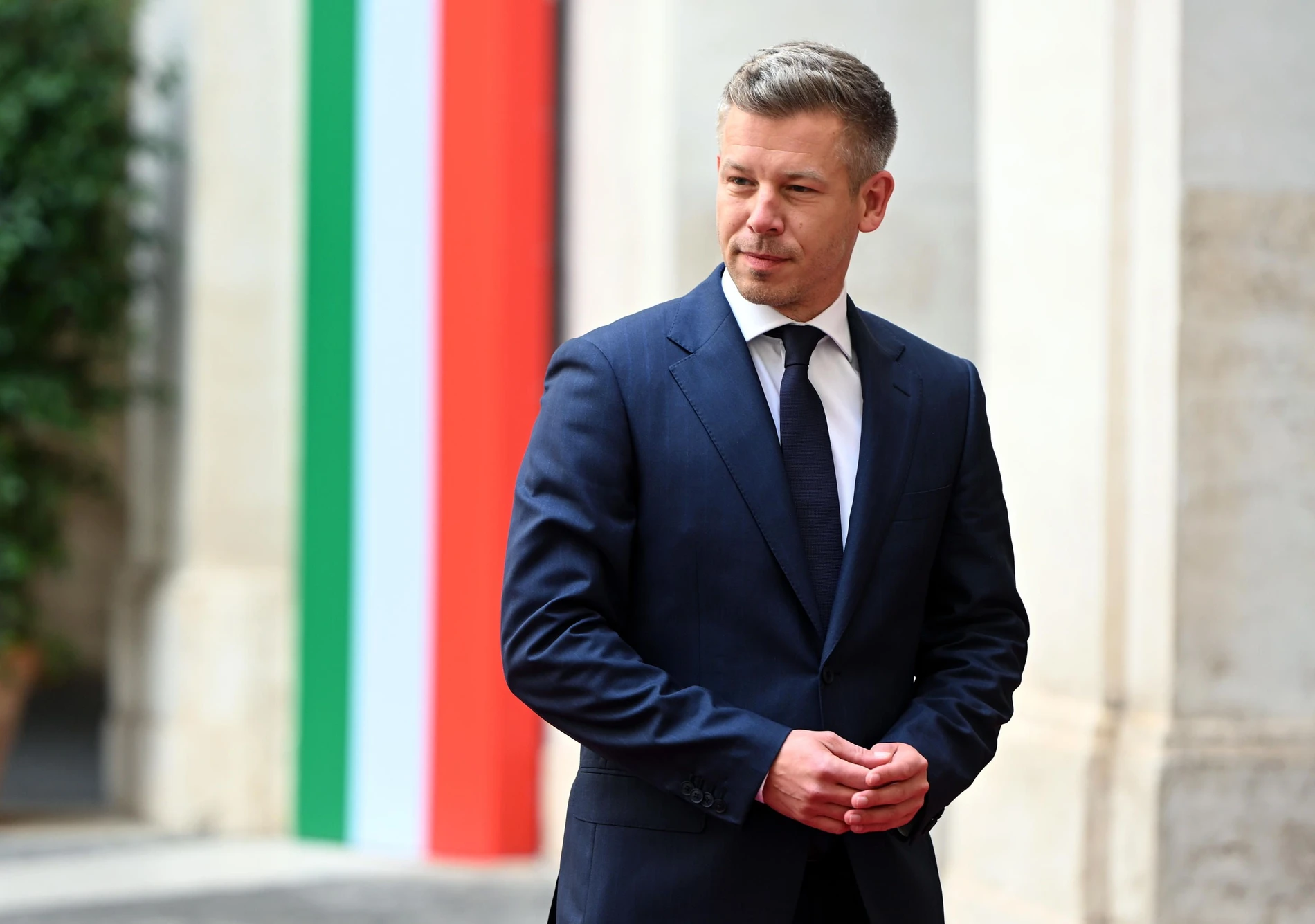
This should be the model for anyone who genuinely wants to weaken the AfD: not exclusion, but a better offer. If Magyar delivers on what he has promised, he could herald a new era in European politics and serve as a template for every CDU member, every FDP voter, every former AfD supporter whose heart still beats for the rule of law and democratic governance.
One must not forget that the AfD is, in considerable part, a reincarnation of the SPD to the right of centre. Its voters are not, for the most part, ideologues. They are citizens who feel that no one takes their problems seriously and who have ended up with a party that at least performs the act of doing so. That is a solvable problem. The CDU could, if it wished, take half the AfD's voters away through pragmatic, honest politics on the issues that actually matter. Fifty per cent, at minimum. But that would require the courage to address subjects for which one receives hostile coverage in certain quarters, and to separate from coalition partners who are ideologically too distant.
Its Driving Them Towards the Far Right
There is a pattern in how progressive and pro-European movements have tried to build enthusiasm for the European project over the past several decades, and it is worth examining honestly, because I believe it has badly misfired. The pitch, broadly speaking, has been this: the old is outdated. We are moving beyond the post-war order, beyond the old cultural frameworks, beyond the old national identities. We are transcending all of that towards something new. Leave the past behind and step into the future.
It sounds appealing in a seminar room. In the real world, it has produced the opposite of what was intended. The more rapidly a population is encouraged or pressured to move away from its traditional cultural self-image and sense of collective identity, the stronger the gravitational pull back towards traditionalism and nationalism becomes. This is not a fringe observation. It is one of the more consistent findings in the political psychology of the last twenty years, and it is playing out in front of us in real time.
I agree entirely with the premise that we need to move away from narrow nationalism. But the direction of travel matters enormously. The answer to nationalism is not to dissolve or demean the attachments that underlie it. The answer is to redirect those attachments towards something larger: towards Europe. And that requires taking those attachments seriously rather than treating them as embarrassments to be overcome.
The social engineering problem
What has actually happened over the past thirteen or fourteen years is that a certain class of political and cultural actors, whom one might generously call social engineers, have tried to use the European project as a vehicle for a broader cultural transformation. The old attachments to regional and national identity were to be left behind. In their place: a new, post-national European identity, built on progressive values, openness and the explicit rejection of whatever came before.
The media establishment, large parts of the press and the mainstream political parties went along with this, broadly speaking. And the results are now visible across the continent. The AfD in Germany polling at over thirty per cent nationally, and over forty per cent in parts of eastern Germany. The Rassemblement National in France approaching similar figures on a national basis. Parties that were once fringe forces have become the dominant political reality for tens of millions of voters.
The people who built this approach are, in many cases, genuinely bewildered by what has happened. They should not be. If you tell a significant portion of the population that their sense of cultural continuity, their attachment to their region, their language, their traditions and their way of life is a problem to be solved rather than a value to be protected, you should not be surprised when they conclude that you are not on their side. And once they have concluded that, they will look for someone who is. The fact that the people they find are often cynical opportunists or outright authoritarians does not change the underlying dynamic.
What pro-Europeans have consistently got wrong
The pro-European federalist movement, of which I consider myself a committed part, has made a version of this mistake repeatedly. Instead of making the case that Europe protects and enhances what people already value about their local and national cultures, it has too often framed European integration as a departure from those cultures. Instead of saying: your Bavarian identity, your Silesian identity, your Breton identity is safe within a strong Europe and would be far more vulnerable without one, it has said: we are moving beyond all of that towards something new.
That framing was always going to struggle. People do not vote to transcend themselves. They vote to protect what matters to them. And if you cannot explain, concretely and convincingly, how the thing you are offering protects what matters to them, they will vote for someone who at least claims to.
The formula, when you state it plainly, is not complicated. Conservative and right-leaning voters cannot simply be excised from society. They are a substantial part of every European electorate and they are not going away. The question is whether they participate in the European project or whether they are driven to oppose it. And the answer to that question depends almost entirely on whether anyone makes a serious, respectful effort to show them that their concerns, their values and their sense of identity have a place within a pro-European framework.
This means, in practice, something that the mainstream has been reluctant to do: dropping the condescension. Not pretending to agree with positions you do not hold. Not abandoning the arguments you believe in. But abandoning the habit of treating AfD voters, RN voters, Reform voters, as if they were simply confused or morally defective people who will eventually come to their senses. They will not come to their senses on those terms, because those terms are insulting.
The posture that is required is different. It says: we do not share the same conclusions, but we understand why you have reached them, and we take your concerns seriously. We are not here to lecture you. We are here to offer a different way of addressing the same problems. And crucially: we are here to show you that what you want to protect, your community, your culture, your way of life, is better protected by a strong and united Europe than by the fragmented, weakened, inward-looking alternative that the parties you are currently considering would produce.
That argument is available. It is also true. A Germany or a France that exits or hollows out the European project does not become more sovereign in any meaningful sense. It becomes smaller, more exposed and less capable of addressing precisely the pressures, economic, demographic, geopolitical, that are driving people towards the far right in the first place. The AfD and its equivalents offer not a solution to those pressures but an acceleration of them, dressed up in the language of national strength.
The migration question cannot be wished away
One cannot discuss this honestly without addressing migration, because migration is the single most powerful motivator behind the AfD's growth and behind the broader surge in right-wing populism across Europe. I have said this already in this essay and I will say it again, because it bears repeating: handing this issue to anti-European parties by treating anyone who raises it as a moral suspect is one of the greatest political own goals of the past decade.
The migration crisis is real. Its consequences, for social cohesion, for public services, for the cultural confidence of communities that have changed rapidly and with very little say in the matter, are real. Pretending otherwise, or responding to people who raise these concerns with accusations rather than arguments, does not make the concerns go away. It makes the people who raise them angrier and more receptive to whoever is willing to take them seriously, regardless of that person's other qualities or intentions.
A pro-European movement that is serious about winning back right-leaning voters must be willing to engage with this honestly, to offer concrete policies rather than comfortable evasions, and to make the case that a coordinated European approach to migration is both more humane and more effective than the nationalist alternatives on offer. That case can be made. It is simply not being made, because making it requires saying things that generate disapproval in certain editorial offices and party headquarters. If none of this changes, the trajectory is clear.
Alice Weidel, Jordan Bardella and their counterparts across Europe will continue to grow. In a decade or two, a political landscape in which figures like Höcke hold senior ministerial office is not a fantasy. It is a projection. Nobody who genuinely values democratic governance and European solidarity should find that prospect acceptable. And nobody who finds it unacceptable should continue to rely on a strategy that has demonstrably failed for thirteen years.
The path out is not comfortable. It requires honesty about what has gone wrong, generosity towards people whose politics one does not share and the courage to offer real solutions to real problems rather than the management of optics. But it is the only path that leads somewhere other than where we are currently heading.
What is at stake
I do not wish to be melodramatic. But I also refuse to pretend that none of this has consequences. If nothing changes fundamentally in the culture of discourse and in the willingness of established parties to offer real solutions rather than managed outrage, I see no realistic scenario in which the AfD does not continue to grow over the coming years. And the effects would reach far beyond Germany. A Europe in which parties like the Rassemblement National, Reform UK, Fratelli d'Italia and a strengthened AfD set the agenda in 2028 or 2029 is not a hypothetical nightmare. It is a plausible projection based on current polling trends. In such a Europe, the confrontations between political camps will not become quieter. They will become louder and sharper. I do not want that. I want a Europe that holds together. And I am firmly convinced that achieving it requires intelligent people from both left and right.
A personal closing word
I have experienced first hand what it means to speak openly about these things in Germany. One is attacked, sometimes even when one has explicitly positioned oneself against the AfD but commits the error of trying to understand its voters rather than despising them. The system devours, in an almost Kafkaesque mechanism, those who seek a more nuanced path.
I say this not to invite sympathy. I say it because it is symptomatic of the larger problem. Whoever genuinely wants to defeat the AfD must stop fighting it with noise. They must start solving the problems for which it is being voted, pragmatically, honestly and in a pan-European framework.
This is not a revolutionary idea. It is, in fact, the most obvious thing in the world. And yet for thirteen years, we have done the opposite.
It is time to stop.