Commentary • European Affairs
A Ban Would Be the Ultimate Win
Proscribing the AfD would hand the Eurosceptics their ultimate victory.
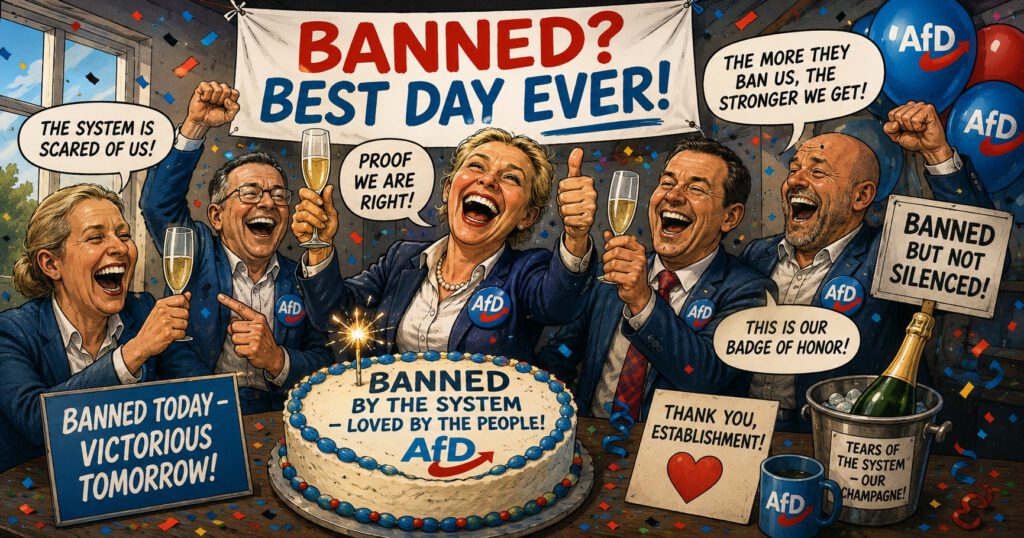
In short: Should the AfD be banned?
- A ban would not remove the AfD's voters. Behind its 30 per cent stand millions of people who would read a ban as proof that their judgement does not count.
- History shows that proscription strengthens movements: Bismarck's anti-socialist law and his Kulturkampf both backfired.
- The better path is to out-argue and out-govern the AfD, and to strengthen the pro-European forces inside the party against the anti-European ones.
Erfurt, first light. The delegates were already in the hall while the city outside was still being dressed with barricades. Motorways were blocked, tens of thousands filled the streets, journalists were beaten by people who had come, by their own account, to defend democracy. The AfD’s party congress is taking place again. By the time the Antifa blockade stood, there was nothing left to blockade. The congress ran its course, the party leadership was confirmed in office, and the protest achieved what this kind of protest reliably achieves; pictures that help the other side.
I am usually the first to attack the anti-European policies and instincts inside the parties we file under the label “right wing”, especially as a pro European, because our task on this continent is not the deregulation of resentment but the rescue of a civilisation, and an AfD positioned against the European Union as it currently is does that task no favours. All of that stands. And precisely because it stands: a ban of the AfD (ESN) would be the victory of the Eurosceptics.
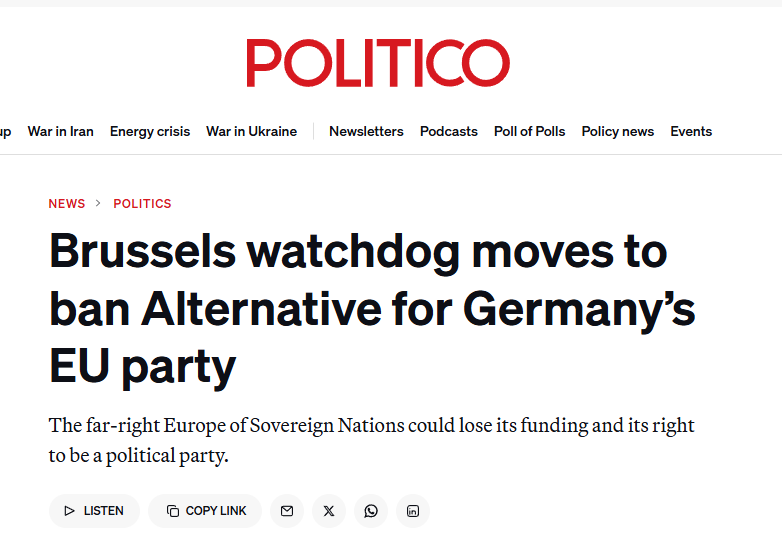
The arithmetic of a ban
Let’s begin with the arithmetic, because the numbers are brutal. Germany is Europe’s most important economy and carries the largest share of the Union’s budget. A Germany that turned against Europe, a Dexit, would not weaken the Union; it would end it. The strongest political force in this country is now the AfD, at 30% in the latest surveys, some 9 to 10 points ahead of a governing CDU stagnating near 20 and trending downwards. These are the numbers on the table when people in Berlin and Brussels talk, with a straight face, about removing the party from the ballot.
A party is an abstraction; a voter is not. Behind that 30% of the country stand millions of individual judgements, each formed by a person with a biography, a street, a set of opinions and a set of reasons for them. What does a ban say to that person? It does not say: you are mistaken, and here is the argument. It says: your judgement and you as a voter are not important for us and you are out. There is no faster way to convert a grievance into an identity. Human beings do not abandon a conviction because it has been punished. They conclude that the conviction must have frightened somebody, and they grip it with both hands. Hence why is the AfD already at 30%?
Whoever believes that outlawing a party deletes its voters has confused the map with the territory, and will meet the territory soon enough.
Vital institutions argue. Exhausted ones proscribe.
There is a name for the instinct behind this project, and it is not love of the constitution. It is ressentiment and vengeance; the reflex of a moral order that can no longer persuade and therefore reaches for prohibition. Vital institutions argue. Exhausted ones proscribe. A political class confident of its own future does not fear an opposition polling 30%; it looks forward to beating it in the open. If they lose, it’s only on them. The ban fantasy is not a show of strength, it is the ultimate surrender.
What German history teaches
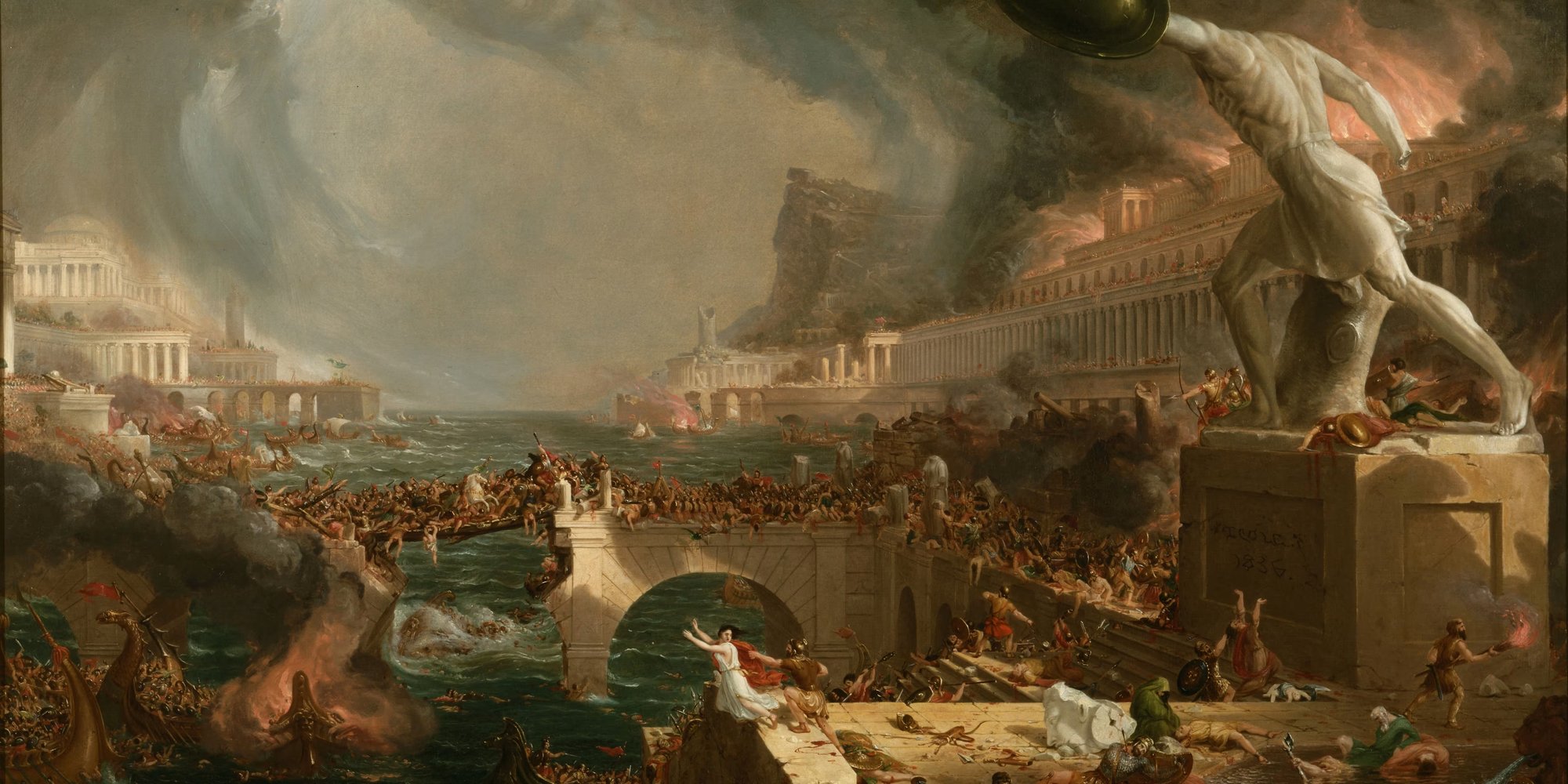
German history has run this experiment twice, under near laboratory conditions. Bismarck outlawed the socialist movement in 1878; when the law lapsed in 1890, the movement stood stronger than before, and by 1912 it was the largest party in the Reichstag. The same chancellor waged his “Kulturkampf” against political Catholicism and manufactured half a century of Zentrum (a Catholic party) loyalty in the process. Proscription did not weaken the suspicion that the state was an enemy of its own citizens. It just helped it grow. Whoever wants the longer perspective may consult Rome, where a republic that answered its tribunes with emergency decrees and, in the end, with clubs did not thereby save itself; it merely announced which phase of its history it had entered. What followed was not the restoration of the Senate but Caesar. Civilisations are rarely murdered by their oppositions. They resign.
Why a ban does not defeat a movement
There is also a logical error at the core of the idea, and it is elementary. A movement that is banned is not negated. The neo-Nazi, communist and Islamist scene proves that no matter how much you try to forbid them, they will only become smarter in adapting – and, for some, they may become a martyr, relieved of the burden of responsibility, sealed against the correction that power and scrutiny impose on every governing party. Genuine overcoming runs through a contradiction. And the contradiction is already at work inside the party or organisation itself.
Around convinced pro-European and decidedly anti-Russian figures in a party that has spent years sounding like Moscow’s advocate, a current of pro European, pan-European thinking has formed. Against it stand the old instincts, strongest in the east, personified by men and women who still mistake Brussels for the enemy and Moscow for the saviour. The decisive question, for Germany and for Europe, is the ratio: how much of this party is Eurosceptic by conviction, and how much of it is simply not leftist? A ban answers that question in the worst possible way, permanently, on behalf of everyone.
What the language conceals
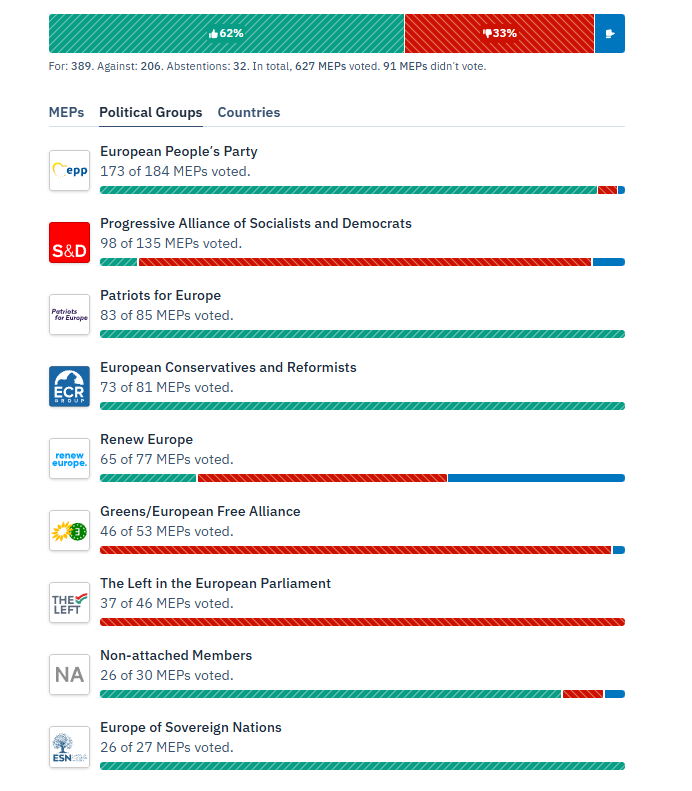
It is worth listening closely to the language in which the project is defended, because the language conceals more than it discloses. Defending democracy here names a procedure by which the largest opposition party is removed from the ballot. “European values” names a criterion that none of its users can state. When words begin to work like this, thinking has stopped and one should ask what the words are built to avoid. The answer is a change nobody in the relevant offices wishes to discuss. The European Parliament currently holds a majority right of centre, assembled from the right wing of the EPP, the ECR, the PFE and ESN; and that majority is able to block left wing projects. On migration the Union has lately been more consistent than most European leaders under a right wing government.
The vote on deportation centres a few weeks ago sent a signal through the entire system. This, and not any fresh reverence for constitutions, is what changed. The ban is not a response to the AfD. It is a response to losing.
Political honesty
Follow the logic one step further and it collapses on its own. Suppose the procedure succeeds, in Karlsruhe or in Strasbourg, after the years such proceedings require. The voters do not evaporate. They move to whatever stands one step further next to them, to the PFE, or they flood into an EPP that would then contain more former AfD voters than any Merz could discipline. What is banned after that?
Meanwhile the outlawing of what is probably the largest opposition party in Europe would be studied, gratefully, in Moscow and Beijing, where nothing serves the propaganda of the multipolar order better than Europe demonstrating that its parliaments tolerate dissent only up to a certain size. One does not defend the open society by performing, at scale, the accusation levelled against it. Of course, many of the people making these claims do not care about “European values” themselves. But that is irrelevant here. What matters is that Russian propaganda is eager to seize on mistakes like these.
What to do instead
So the counsel is simple, and it is offered in Europe’s interest, not the AfD’s. Do not do it. Work with the pro-European forces inside the party and strengthen them against the Russian, Chinese or American temptations. Make plain, patiently and in public, how fatal the anti-European instincts are for the very goals these voters hold, because without a strong European level there will be no migration reform, no economic revival, no defence worth the name, not in a world of continental powers gnawing at our edges. Britain has left. In Paris and Berlin the Eurosceptics are positioned to win, and the notable fact of this decade is that Bardella and the wing around Weidel are drifting towards Europe, not away from it. That pattern is the future of the continent, if the continent wants one, and it should be reinforced rather than fought on the grounds that it is insufficiently left.
In Erfurt the party simply got up earlier than its enemies. There is a lesson in that small fact, and it is not flattering to the people who intend to answer 30% of the electorate with a court order. A civilisation that still believes in itself does not ban its opposition. It out-argues it, out-governs it, out-performs its critics, outlasts it. Everything else is a coronation, staged and paid for by the losing side.